
Understanding Ocean Conditions for Salmon
Variations in temperature, currents, and nutrient availability influence the entire marine food web, from plankton to marine mammals and seabirds. In the Pacific Northwest, ocean conditions are dynamic making ecosystem responses difficult to interpret using a single environmental variable. To address this challenge, scientists create ecosystem indicators using summaries of many different measurements to track patterns over time. Ecosystem indicators help translate complex scientific data into accessible information that can guide management decisions and inform the public.
The NOAA Northwest Fisheries Science Center (NWFSC) monitors ocean conditions off Washington and Oregon to better understand the northern California Current (NCC) ecosystem. Researchers there have developed indicators that summarize and contextualize the complex physical and biological data they collect. These indicators are used to understand how large-scale climate patterns, local environmental variability, and prey quality influence the survival of juvenile salmon. Salmon are an ecologically and culturally important species in the Pacific Northwest.
An overview of the tools they have developed are below, more information about each indicator and how the tool is developed and used can be found on their website.
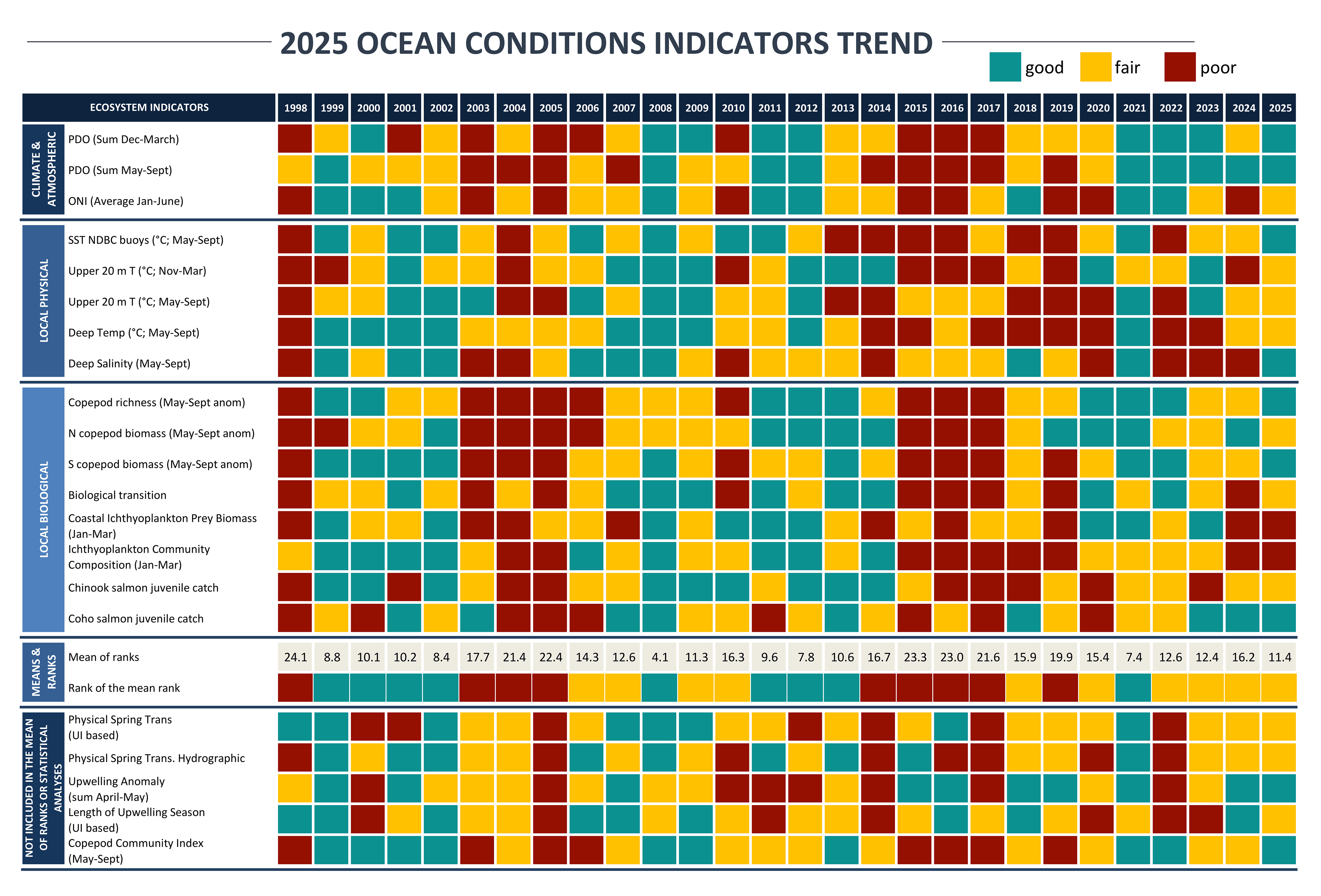
The stoplight table developed by NOAA NWFSC displays conditions as good, fair or poor relative to supporting juvenile salmon, for a given indicator and year.
Climate and atmospheric patterns, such as the Pacific Decadal Oscillation (PDO) and Oceanic Niño Index (ONI), provide information about broad-scale ocean and climate conditions across the Pacific basin. These large-scale patterns interact with local environmental conditions to shape the habitat experienced by juvenile salmon. Local conditions do not always mirror basin-scale climate patterns and can either lessen or amplify their effects on habitat quality and availability. This is why it is important to consider multiple indicators simultaneously when trying to understand biological outcomes. Unfavorable conditions can cause stress on juvenile salmonids and have cascading impacts on food availability and quality. Given that juvenile salmon and their prey may have different optimal conditions, the timing of seasonal transitions is also important when considering growth, survivability, and overall ecosystem productivity.
In general, warmer ocean conditions are often associated with less favorable conditions for juvenile salmon and their prey. This pattern is reflected in the stoplight table by an increase in red indicators. These periods are associated with warmer temperatures, lower abundance of ichthyoplankton prey, and reduced prey quality. To learn more about the indicators displayed click the indicator name on the left. To explore their combined effects, use the annual means and ranks, which summarize overall conditions across indicators for a given year. Higher values indicate less optimal conditions for juvenile salmon.
For more information on each individual indicator, click on its name below:
Variable names in multi column list under the headers, hyperlinked to a page with the explanations
Want to delve in deeper?
To further explore the patterns visible in the stoplight table, the Northwest Fisheries Science Center has developed an interactive tool that allows you to examine specific indicators and their relationship with observed salmon returns at Bonneville Dam. They use a combination of statistical tools to investigate how well different indicators explain variability in adult salmon counts from year to year and how closely model estimates align with observed returns.