


Statsraad Lehmkuhl One Ocean Expedition
27 October - 3 November 2025
The One Ocean Expedition 2025-2026 is a 12 month voyage aboard the Norwegian tall ship Statsraad Lehmkuhl, aimed at raising awareness and sharing knowledge about the crucial importance of the ocean for a sustainable future on a global scale.
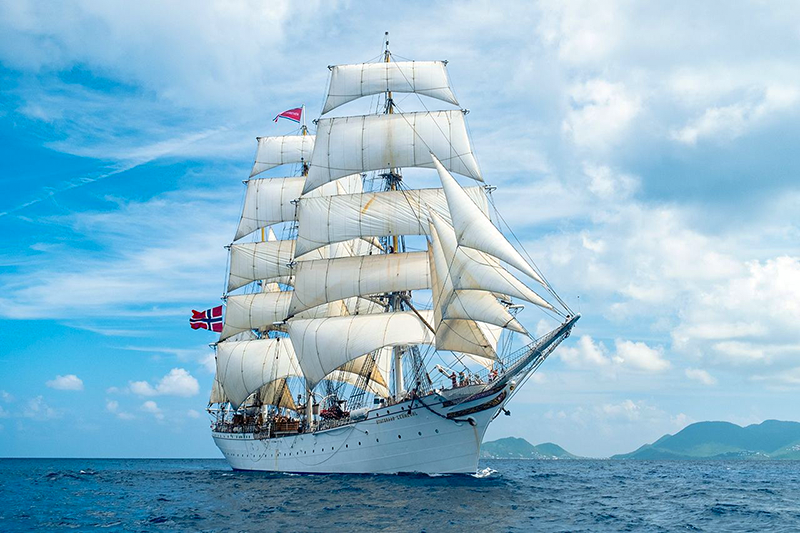
Twelve University of Washington students joined members from NANOOS (Jan Newton and Nick Rome), the Washington Ocean Acidification Center (Hana Busse), and Washington Sea Grant (Chandler Countryman) aboard the historic Norwegian tall ship Statsraad Lehmkuhl from Seattle to San Francisco, 27 October to 3 November, as part of the One Ocean Expedition. The students hailed from the University of Washington School of Oceanography, School of Marine Affairs, Marine Biology Program, and Law, Societies, and Justice Department, and ranged from a sophomore undergraduate to a Ph.D. candidate. They contributed to the Voyage Crew, a diverse group of 63 sail trainees from ages 16-80 years old from multiple communities, backgrounds, and interests.
The Seattle-based Washington Maritime Blue, a strategic alliance dedicated to accelerating innovation in the Blue Economy, chartered the leg from Seattle to San Francisco. Student support was provided by Maritime Blue, UW Global Affairs, UW College of the Environment, UW School of Oceanography, and NANOOS.
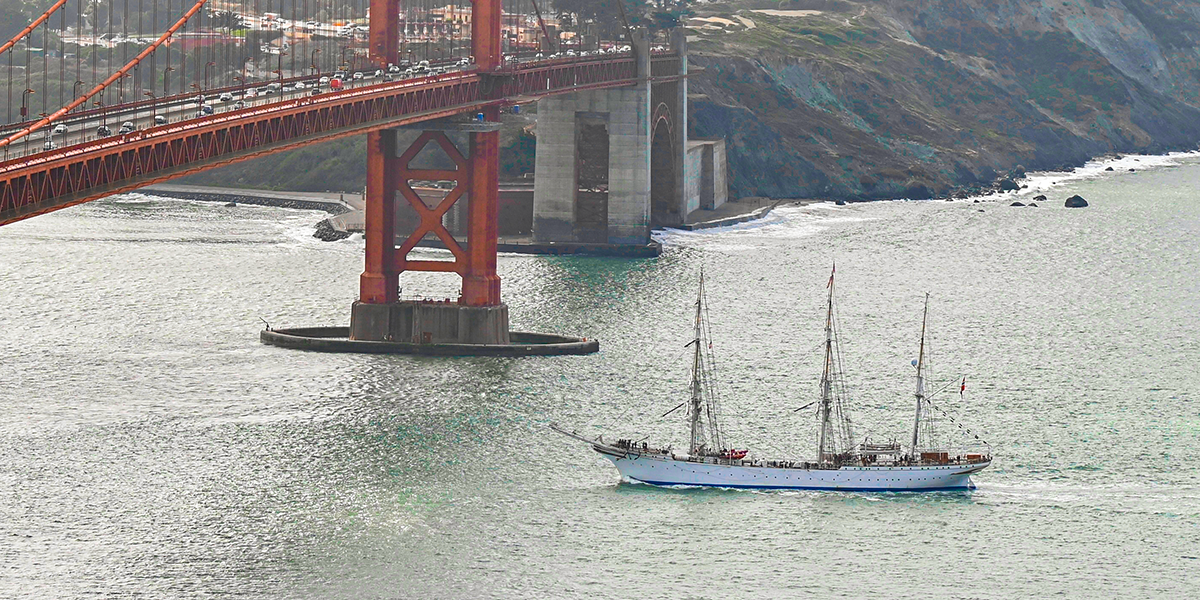
After sailing 915 miles we arrived in San Francisco with all aboard, new data, and many stories! Together three watches worked to steer the ship, hoist her sails, scrub her decks, take data from multiple sources, and learn so much from each other. We did CTD casts and net tows, as well as mine the ships flow-through ferry box and acoustic systems for data to study water masses and biota. Students also sampled for foraminifera, eDNA, and microplastics, took care of a novel salinity sensor being tested by Applied Physics Laboratory-UW (PI Anuscheh Nawaz), and an imaging flow cytobot was used by the Washington Ocean Acidification Center and NANOOS (PI Ali Chase). We held an "Ask an Oceanographer" session where other crew members could ask questions of all our scientists. It was truly an experience of a lifetime that we will never forget.
Below, in their words, we share reflections from each student, sharing what this journey meant to them.
Mateo Bonta
Undergraduate Sophomore, Oceanography
It's a very heartwarming feeling to be able to put faces to so many names after just one week of being together. But it's not at all surprising that this occurred so seamlessly. At the end of the voyage the sense of community was strong enough to the point where I would do it all over again for triple the amount of time. As expected, the research done onboard, the watches (even the early AM ones), the meals we all ate together, the ship crew, and the ship itself were all so fun and engaging. I learned so much from the Science Director Lucie and the team of Norwegian deckhands.
What was not expected were the professional connections that I made during my time on board. The group of maritime industry professionals that I got to talk to and get to know were so open to giving me great advice in next steps for my career and happy to give me their contacts in the need of future support. I learned so much about how the ocean industry works that I've never learned in the classroom, which shows how important an immersive experience, let alone on the prestigious ship of the Statsraad Lehmkuhl, is so important. It was so cool to see everyone talk amongst each other nerding over technologies, career paths, and developing connections of their own. Overall I am very thankful for this once in a lifetime opportunity to sail on a ship of this caliber with people of even greater caliber.
Brooke Carruthers
PhD Student, Oceanography
I couldn't have asked for a more amazing first research cruise! As a young oceanographer just starting out in the field, the chance to sail aboard the Statsraad Lehmkuhl and learn about traditional sailing practices (thank you to the Norwegian/Danish crew for being so welcoming!), alongside participating in shipboard science (huge shoutout to Lucie our science coordinator!!), was a dream come true and will be a cornerstone in my career going forward. On top of the sailing experience, the chance to interact and speak with diverse folks from across the University of Washington, Maritime Blue, and also general ocean and sailing enthusiasts about current research, potential applications, and current industry start-ups, was an invaluable learning experience. Bonding together over shared exhaustion, late-night watches under a sky full of stars, seasickness, and childlike joy while learning how to be deckhands on a beautiful sailing vessel created a unique sense of camaraderie that broke down barriers and encouraged conversation between industry leaders, professors, and young students like me just beginning to find our way.
It was particularly notable to have so many conversations about the future of the blue economy aboard a piece of history preserving sailing tradition and culture. How surreal to have modern ocean innovation heralded by a ship of old; to me, that continuity underscores the power of the ocean to connect and inspire across generations, backgrounds, and cultures. I came off the boat chomping at the bit to share my insights and experience and new network with my research colleagues to get them involved and thinking about the blue economy. I would sail aboard Staatsrad Lehmkhul again in a heartbeat, and I am beyond excited to see where (and with whom!) she sails next!
Leo Couchon
Undergraduate Student, Oceanography
The introduction the Statsraad Lehmkuhl held for its passengers aboard leg 15 of the One Ocean voyage was one I was ill prepared for. The largest and most ancient sailing ship the Norwegian fleet has to offer was home for over 900 nautical miles from Seattle to San Francisco. The voyage began with the intent to avoid a storm by anxiously awaiting on the outskirts of the Sound, tucked into the outlet of the estuary awaiting a moment of clearance for the Pacific Ocean’s invitation. It came when we could no longer wait and ventured forth, setting sail into the very eye we’d hoped to wait out. As the storm greeted our entry into the open ocean I found peace within the torrent. I still struggle to believe anything I get to do is real, I am constantly grateful for every opportunity I get to learn from and encounter. As the Statsraad Lehmkuhl leaned me forward into the face of the water, closer than I thought possible for a vessel so large, with the bioluminescence from the hull stirring below the broken surface tension of the water, I would turn to the 5 meter waves causing a preemptive lean that felt as though it was ready to toss me overboard. I felt as though the unbroken wall of deep blue towering over me could swallow us without hesitation. It would glide below and the mast would dance with the stars above, nearly kissing the water as it swept its movements from side to side. A dance between two I could only witness in awe and brace myself for, as the decks washed with salt water and toppled those heaving sick into its gutters with a bath.
Nana, my watch lead that in my head I quietly admired but reckoned with as the commanding voice of the 4-8, expected us awake and ready on deck by 3:50 till 8 am and pm. A minute later than 10 minutes early is late she’d say joyously as we groaned on our uneasy sea legs in the snapping cold of the dark mornings. The labor was a kick into action I accepted happily as my mind and hands were never left taskless. This said, I had not anticipated the requirement of being above deck no matter the conditions. The first two mornings I crawled my way into the galley at the tail end of breakfast sniffling without the ability to feel my toes or fingers with every layer stiffly soaked through. I still found myself warmed by the kindness of my shipmates as I was offered by Jan, my mentor aboard the ship, a heavyweight hoodie with our home University’s R/V Rachel Carson branding from the University of Washington’s School of Oceanography that I wore religiously for the duration of our expedition. From John, a fellow student, I was offered tan Carhartt gloves of brushed suede. It felt like I had been given armor. In fairness, I am a college student who was told strict dimensions of space were to be provided and I adhered to the rule to avoid any inconvenience aboard (that would then lead to an extra carry on fee at the airport for the way home: another motivating factor) but it seems that my caution in one direction taught me how to endure, and by the end of the voyage, feel comfort within, the same cold winds that carried our sails.
As I reflect upon the leg of this expedition I was fortunate enough to live, I think of our hands. By the end of the cruise, all of our hands were calloused in a variety of new ways and bleeding from the rope burn in others. They were the hands that ate together in the galley after time on deck, heaved with their watch, held hands to stabilize shipmates within sways, and that waved goodbye bearing new stories.
Victoria deJong
Undergraduate Student, Oceanography
Sure, I will gladly regale you with jaw-dropping stories of the humpback whale that resurfaced from cobalt waves again and again, greeting us as we first saw green along the horizon after seven days of panoramic blue. I can describe the surreal experience of standing near the helm during a tumultuous storm, waves crashing over the rails as the 48‑meter mast swung like an upside‑down pendulum tracing crescents beneath the stars. Perhaps, I paint the otherworldly sensation of sailing through a flattened orb of grey, where the three dimensional world collapses into two serene dimensions as monotone sky and ocean envelope you in mist, distinguishable only by the textural gradient from matte air to reflective water. Or, I can share my excitement as a budding oceanographer assisting the chief scientist with global data collection, taking careful oxygen isotope samples and calibrating prototype salinity sensors from the Nawaz Lab aboard this breath-taking tall ship.
But, would you believe me if I told you the most unforgettable experience was scrubbing the decks? Forming a grid, we aligned our deck brushes and scrubbed and stepped our way across the 100-year-old deck, calling out in methodical unison, "Left right, left right, left right". An inefficient way to clean yet an extremely efficient way to train awareness of self and neighbor in space, this synchronization allowed us to achieve truly marvelous feats. Using only our bodies, simple pulleys and ropes, we fifteen lifted a 3-ton mastyard! From hoisting sails to daily chores, my cruise highlights were simply chanting and laboring in unison with near-strangers. It felt sacred. It felt like dancing.
As an undergraduate at the precipice of graduation, I stepped aboard the Lehkmuhl riddled with uncertainty. How can I design my future in academic research and community-rooted climate action when I want to study tiny fossils in ancient ocean mud?!?! Little did I know, the clues were in my motley crew: from scientists and engineers to environmental entrepreneurs and lifelong sailors, my watchmates had wisdom spanning generations (Vicky celebrated her 70th birthday at sea!). Folks from local organizations SeaGrant, Maritime Blue, PacClean, and NANOOS shared stories of on‑the‑ground, community‑driven marine innovation and cross-discipline coalitions. Chanting alongside this chorus of doers and dreamers committed to science and action reignited my sense of purpose as a scientist, reconnected me with my identity as an activist and illuminated my path forward centering both curiosity and justice. I skipped off the gangway lightened by hope and clarity, feeling as though I had spent a week dancing with old friends.
Jonas Donnenfield
PhD Student, Oceanography
Hand over hand, I climbed the slick, rope ladder of the starboard side rigging. The moon illuminated my way while fog blurred the line between sea and sky. The weather-roughened rope bit into my palms as I ascended, but I barely noticed. The Statstraad Lehmkuhl swayed back and forth as the Pacific Ocean swelled beneath the hull, causing me to tighten my grip. The thrill of my precarious perch high above the water drew an involuntary smile across my face. As I approached the royal yard, I paused to look down at the scene below, and my breath caught. The ocean shone like mercury, and the deck glowed with soft red lights. It felt like a painting from an old master—of a ship lost at sea or the calm before a storm. The ocean rose; the ship tipped again, and inertia pulled me outward from the rigging. I pressed myself tight against the ropes and looked up. Above me, the silhouette of my Norwegian crewmate waited to guide me along the yard. Everything about this night felt surreal, and yet I had never been so aware of being alive.
That climb was one of many highlights of my time aboard the Norwegian tall ship Statsraad Lehmkuhl, a 111-year-old training vessel. As an oceanographer, I've learned that life at sea offers moments that are both magical and miserable—sometimes within the same hour. I never anticipated the chance to learn to sail alongside expert mariners while conducting science with a remarkable crew. The experience deepened my appreciation for the skill, endurance, and coordination that both oceanography and traditional seamanship demand, and reminded me that the ocean rewards patience, humility, and presence. Crossing beneath the Golden Gate Bridge into my hometown of San Francisco was a full-circle moment: I had left San Francisco to become an oceanographer, and I returned to it by sea. Stepping off the ship, I carried renewed respect and wonder for the ocean, and deep gratitude for everyone who has buoyed me along my voyage.
Madison Gard
Graduate Student, Master of Marine Affairs
Sailing aboard the Statsraad Lehmkuhl during the One Ocean Expedition was transformational. The 111-year-old Norwegian tall ship docked at Pier 66—its masts towering over Seattle's modern waterfront—left me awestruck before I ever stepped on deck. What began as a group of strangers boarding a historic vessel quickly became a patchwork crew and community, stitched together by shared curiosity, long shifts of line-handling, and the routines of life at sea. Sharing the many reasons people joined the voyage—career inspiration, research, lifelong dreams of sailing, pure adventure—made us a quilt of different fabrics, each one unique and essential.
In our first days off the coast, the Pacific Ocean humbled us with wind, rain, and swells taller than any I've ever experienced. Our collective endurance was rewarded when the sea eventually calmed, softening into glossy horizons soaked in a stunningly golden sunset. I witnessed magic the morning I rose for my 4 a.m. watch to reach the deck and find water shimmering with its own blue starlight, each wave glowing and sparking–my first time seeing bioluminescence. Between watch shifts with the crew, I immersed myself in research, actively sampling environmental DNA and sharing my studies with new friends huddled around filtration gear or gazing out over the rails of the ship. Sleeping in hammocks, gathering for meals, and working the watch-posts became a treasured routine over the course of eight days.
By the end of the voyage, I felt deeply inspired by the way Maritime Blue and the One Ocean team weave together research, industry, policy, and outreach. It was an honor to be part of the tall ship's historic global journey—a floating ambassador for the UN Ocean Decade—and the experience left me with a renewed sense of purpose. This voyage reminded me why interdisciplinary work matters and how science, when shared openly and joyfully, can spark action for sustainable futures.
Amelia Hargreaves
Undergraduate Senior in Law, Societies, and Justice
I first heard about the Statsraad Lehmkuhl and the One Ocean Expedition in the spring, when Joshua Berger, the founder and CEO of Maritime Blue, spoke in my Climate Governance class. His brief mention of the upcoming voyage from Seattle to San Francisco immediately caught my attention. I had no idea what to expect, but I knew I couldn't let the opportunity pass me by, and after eight days aboard the Lehmkuhl, I'm so grateful I took that leap of faith.
This experience was particularly special for me because my grandfather, Gordon Hargreaves, graduated from the University of Washington, spent most of his life in the San Francisco Bay Area, and was an experienced sailor. I grew up hearing stories of Trans-Pacific voyages on the 58-foot sailboat Natoma: 2,225 nautical miles of shifting weather, relentless sail changes, and sleepless nights tossed around by squalls in bunks (I'm sure they wished they were sleeping in hammocks instead). Aboard the Lehmkuhl, I came to understand the undeniable beauty of being out in open ocean: the bright path of the waxing moon over an ever-changing rhythm of water, stars extending all the way to the horizon, bioluminescent algae dancing behind the propeller, soupy fog blurring the line between the sea and the sky. I couldn't help but think of my grandpa, out on that very ocean, under the very same sky of stars, more than forty years ago.
As Natoma's skipper Donald B. Dalziel said, "If you have a good boat and a good crew, you'll have a good time." We undoubtedly had both. Our days at sea were defined by camaraderie: learning to coil ropes, set and furl sails, keep watch, and man the helm. We played games, sang folk songs, and even on a day of awful seasickness, there was still laughter and excitement over shared meals below deck. An eagerness to learn brought together a group spanning generations, disciplines, and backgrounds. This experience deepened my understanding of climate stewardship and broadened my thinking about my own planned path in environmental law. Most of all, and what I know will stay with me long after this voyage, it reaffirmed the enduring value of learning in community.
Zoey Harvey
Undergraduate Senior, Marine Biology
As I stared idly up at the stars intricately woven into the sky above me, a sudden exclamation shook me from my stupor. A crew member, face alight with excitement, beckoned me to the ship's side to peer into the water with her. At first, all I could see was an endless expanse of serene near black water that mirrored the sky. And then there it was. Little fluorescent beams would materialize and fade, briefly washing the surrounding water in a pale turquoise. The first watch, Kamilla, caught wind of our sighting and brought us to the stern. She informed us she'd turn off the ship's lights for just a while. We watched as the ocean and stars communicated in a language we couldn't comprehend. In between the waves lapping against the ship's hull, gentle gasps and murmurs of delight could be heard as each pool of light took shape. No one glimmer was alike, and each was equally intoxicating, as that kind of ocean magic never grows old. What felt like a lifetime and yet somehow also a few moments later, Kamilla had left us, and the ship's lights illuminated the water yet again. We stayed at the stern a bit longer, not yet ready to leave such a moment behind. It is a precious thing to be made a child again by Mother Nature, let alone to experience it in community.
That shared sense of childlike amazement is what made the voyage on the Statsraad Lehmkuhl so exceptional. In a world so sensationalized, it is far too easy to forget how it feels to be wonderstruck, to feel your jaw agape. As a marine biologist, I am forever grateful to the ocean for reminding me when I need it most that it is this feeling that inspires all I do. To be continuously humbled by the ocean, whether by way of science or seasickness, and left in reverence, is a gift. These opportunities to unite in curiosity and community are what allow us to incite meaningful change, and this is what the voyage embodied. Together we learned, laughed, struggled, and shared. I stepped off the ship in San Francisco with a renewed sense of purpose, a deeper appreciation for togetherness, and anticipation of what lies ahead. As I go on to graduate, I will not forget what the sea and my shipmates taught me: that science and joy alike are meant to be shared.
Katie Kohlman
PhD, Physical Oceanography
Sailing aboard the Statsraad Lemkuhl from Seattle to San Francisco was unlike any research cruise I've taken as a graduate student. This wasn't a typical working vessel with fluorescent labs, computer screens, and tight scientific schedules. Instead, I found myself becoming part of the ship's rhythm and history. We slept in hammocks that we took down each morning so the banjer could return to being a cafeteria. We stood watch twice a day, steering the ship by hand, scanning the horizon from the bow, or making rounds below deck on fire watch. I learned to haul and ease lines surrounded by towering sails, and climbed the rigging where the wind pressed hard against the canvas and the ocean stretched endlessly around us. It felt like stepping into an older world where time moved with the sea rather than against it.
The days were not always calm or graceful. A passing storm left behind steep rolling swell that had the ship listing dramatically and sent many people straight to the designated seasickness 'puke chute'. Things slid, slammed, and clattered. But even then, dolphins appeared, leaping through the waves and tracing bright arcs of silver foam alongside us. When the seas finally settled, the ship returned to her steady rhythm and we found joy in small quiet moments. Hammock naps, shared meals, the soft hum of ropes under tension, and the glow of the water under moonlight during night watch all became part of the fabric of the experience. We even celebrated Halloween at sea, improvised costumes and all, a reminder that community grows easily when people live closely and intentionally together.
I am deeply grateful for what this crossing gave me. I learned far beyond navigation and sail handling. I learned a slower way of paying attention, a deeper patience, and an appreciation for how to exist with the ocean rather than simply work upon it. Research at sea often feels urgent, full of tasks and protocols, but here sailing and science had to share space, and that required flexibility, respect, and presence. Passing beneath the Golden Gate Bridge at the end of the voyage, with the ship polished and gleaming in the sun, we sang a farewell shanty together. In that moment I realized how much the experience had shaped me. I left with a renewed respect for the sea, gratitude for the community that formed on board, and a reminder that some of the most meaningful learning happens when we allow ourselves to be transformed by the experience.
Marria Peduto
Graduate Student, Master of Marine Affairs
Like many great voyages that have circumnavigated the world and reached faraway islands in the Pacific or sailed through icy seas in the Polar regions, there is always a need for an ethnographer; someone to tell the stories of the hardships and adventures of life aboard a ship. On this journey, that was my goal. I set out to capture our days at sea as an academic, interviewing crew members and learning as much as I could about the history of the Statsraad Lehmkuhl. Yet the voyage became far more than a story to document; it became a slow transformation—a stripping away of everything unnecessary until only the essentials of living and working together remained. I became "we".
In the beginning, every rope, every knot, every order shouted down the deck felt foreign and indeed they were as we learned commands in Norwegian, the working language of the ship. By the end, our hands moved instinctively, guided by rhythm and trust. The Statsraad Lehmkuhl stopped feeling like a ship and began to feel like a living thing. The night watches tested my ability to sit with my thoughts: strength not just in muscle, but in quiet endurance. As a member of the red watch (midnight to 4 a.m. and noon to 4 p.m.), companionship was built in the quiet exchange of work at 3 a.m., when the stars were our only witnesses and our crewmates slept in the banjar below.
Most surprising to me was the powerful feeling of becoming part of the ship itself—its sails snapping to life under our hands, harnessing the energy of wind and sea. The ocean taught patience, humility, and awe. I realized how small a person can feel in the face of such vastness. Sightings of whales, casts of plankton tows, and the reality of lowering a rosette a thousand meters into the sea highlighted the wonder of science, even amid the occasional sample container misfire or storm that stranded us in the Strait of Juan de Fuca longer than we'd hoped. The open ocean made me feel small, yet deeply inspired by the science we carried out. When we finally caught sight of land, it was with a mix of relief and reluctance, knowing the world on shore would never quite match the one we had built at sea. The final day spent coiling ropes, polishing brass, and scrubbing decks for the last time was filled with quiet reverence: for the salt in our skin, the calluses on our palms, and the bond that had formed through every shared task.
What remains most deeply in my mind is how each of us became a necessary part of something greater, every line we hauled and sail we set a thread in the same vast fabric. We learned to trust one another, to listen to the wind, and to find stillness in motion. Leaving the ship felt like saying goodbye to a version of myself that exists only at sea—stronger, steadier, and infinitely more connected to myself. The Statsraad Lehmkuhl will keep sailing, but a part of me will always move with her, carried in the rhythm of the waves to which I will one day return.
John Plinka
Post-Baccalaureate, Marine Biology
When I first learned of the opportunity to sail on the Statsraad Lemkuhl, I thought it would be an interesting way to spend a week and practice some field work. As I wobbled off the gangplank onto a pier in San Francisco, I knew I had finished a life-changing experience. The variety of people working together, the physical trials of learning to sail, and the excitement of participating in ocean science on a hundred-year-old ship combined to create the most unique research experience I have ever participated in. Being a part of a global initiative to engage the public sector with marine science communication embodies my motivations to earn a degree in marine biology.
There were also plenty of challenges aboard. Hauling ropes to move tones of steel inches at a time is a demanding task. It gets harder when your first time hauling ropes in is the dark, during a downpour, without knowing the language the crew is shouting commands in. Deploying scientific equipment requires lots of time and coordination, and if any equipment fails (like the wench hauling the plankton net) there is little opportunity to fix it. Finally, there's the sea-sickness if you're a landlubber like me. The crew reminded us that no one has ever died from sea-sickness, but as the world spins around you like you've had way too much to drink, it sure feels like you may be the first.
Still, though, I wouldn't trade my time at sea for anything. The sickness only lasts the day, and between heaves I was able to spot some beautiful bioluminescence off the side of the ship. I saw the sun rise and set, again and again, over the ocean's limitless horizon. I was able to sing "What Do You Do With A Drunken Sailor?" while hanging from the rigging like a pirate. We met all manner of marine mammals swimming near to check out their unusual intruder. I got to meet fellow scientists engaging in marine sciences, and make friends from groups I would have never met if not for this cruise. I got to be a part of something bigger than myself, or one discipline, or one institution. We got to be active participants in making the world, and ourselves, better than when we started.
| National Observing System Partners NSF Ocean Observing Initiative (OOI) National Estuarine Research Reserve System (NERRS) Olympic Coast National Marine Sanctuary (OCNMS) National Data Buoy Center (NDBC) Coastal Data Information Program (CDIP) Integrated Ocean Observing System IOOS | |||||||